
Mongolia's Political Crisis Is a Silent Bid for Presidential Power

On October 20, President Ukhnaagiin Khurelsukh vetoed an attempt to remove the Prime Minister, citing procedural issues in parliament’s vote.
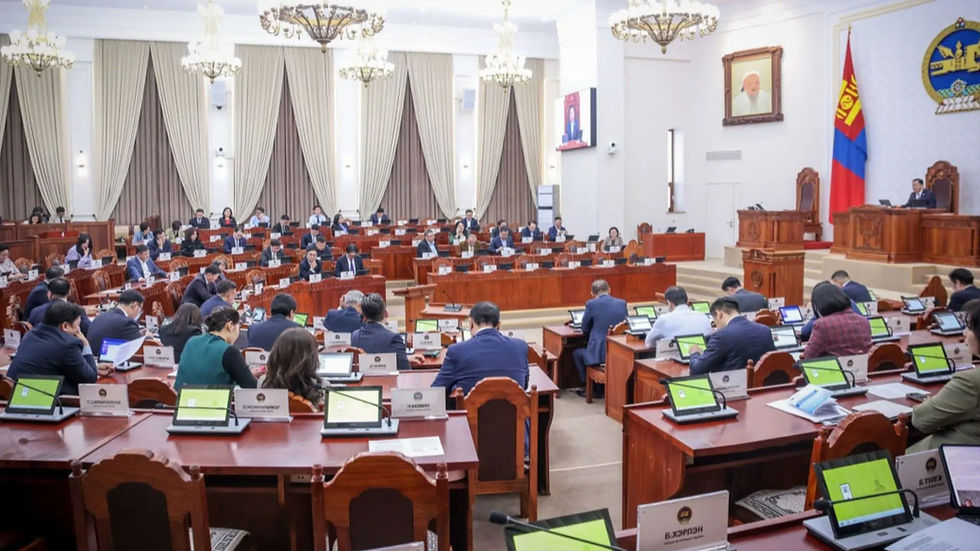
A feud inside Mongolia’s ruling Mongolian People’s Party has erupted into open political warfare between Prime Minister Gombojavyn Zandanshatar and Parliament Speaker Dashzegviin Amarbayasgalan. Governance is frozen at a delicate moment for the economy.
Yet the real contest may be taking place out of sight, where President Ukhnaagiin Khurelsukh could be staging a patient power play that reshapes Mongolia’s constitutional order.

Both men battling today once served as Khurelsukh’s loyal aides (Note: Parliament dismissed the Prime Minister and accepted the Speaker's resignation on October 18, 2025).
Their clash, fueled by rival dismissal petitions and claims of favoritism in the coal sector, might look like a loss of presidential control. In reality, it bears the marks of calculation.
Khurelsukh’s public posture has been pointedly restrained. Speaking at a recent judicial forum, he warned against “the influence of color or the shadow of money.” The remark addressed at the judges, aimed at both warring camps and their business patrons, cast him as moral arbiter while his protégés erode each other’s credibility.
That restraint seems at odds with his record. As prime minister, Khurelsukh championed the 2019 constitutional amendments that curbed presidential power and bolstered parliament and the prime minister. He defended the constitution and the current parliamentary system, as recently as May 2025.
Yet those reforms now look flawed following Mongolia's political crisis unfolding these days. The current stalemate offers him both rationale and opportunity to revisit the balance of authority.
Three calculations appear to guide his hand. First, letting the feud burn on weakens both factions, leaving him indispensable as mediator. A crippled prime minister and speaker will have little choice but to seek his intervention.
Second, parliamentary paralysis provides a plausible case for institutional overhaul. If the system yields gridlock instead of governance, calls for stronger executive leadership will resonate not only among voters but within the elite itself.
Third, time is pressing. Khurelsukh’s presidential term ends in 2027. A shift toward a presidential or stronger executive model could extend his influence while presenting the change as a cure for dysfunction rather than self-interest.
But even this orchestration may mask something less grand than strategy—survival. A growing public narrative blames the country’s economic and social strains on murky, off-book coal sales by Erdenes Tavan Tolgoi, the state miner that dominates the export economy.
The scandal’s roots stretch back to Khurelsukh’s years as prime minister, when oversight of the company was notoriously loose. If the coal-theft story gains more traction, it could ensnare him personally just as his presidential term winds down.
His calm posture may therefore be less about redesigning Mongolia’s political system than about staying a step ahead of a gathering storm.
Far from indecision, his silence reflects tactical patience. The longer the crisis lasts, the more credible a presidential solution becomes. Economic urgency will amplify that logic. The national budget is stalled, investment approvals are frozen and key infrastructure projects are adrift.
Business leaders and foreign partners increasingly value predictability over process—a sentiment Khurelsukh is poised to harness.
The stakes extend beyond domestic politics. Mongolia’s role as a democracy wedged between China and Russia depends on steady institutions. A power vacuum in Ulaanbaatar unnerves both investors and international partners, particularly as the country seeks to modernize its mining governance and energy grid. Many may quietly welcome a decisive stronger hand, even if it bends the current rules or sidelines the parliament.
How Khurelsukh plays the coming days will define his legacy. The parliament moved to dismiss Zandanshatar on October 18 and the president vetoed the decision. Overriding that veto requires 84 votes, an impossible threshold given the ruling party split.
The prime minister would limp on as a figurehead, leaving Khurelsukh to pose as national stabilizer above the chaos.
If he lets Zandanshatar fall, he still wins. A discredited and now resigned Amarbayasgalan is unlikely to command a majority, forcing parliament to seek a compromise candidate—a government the president can quietly shape. Either way, Khurelsukh consolidates power without direct confrontation.
What looks like a Mongolia's political crisis may be an opportunity for the presidency. Yet beneath it lies a trace of panic.
The president who once sold himself as reformer is now maneuvering not only to outplay his rivals, but perhaps to outrun his past.


Comments