
Zandanshatar’s Moment: A Transitional Premier or the Next Power Center?

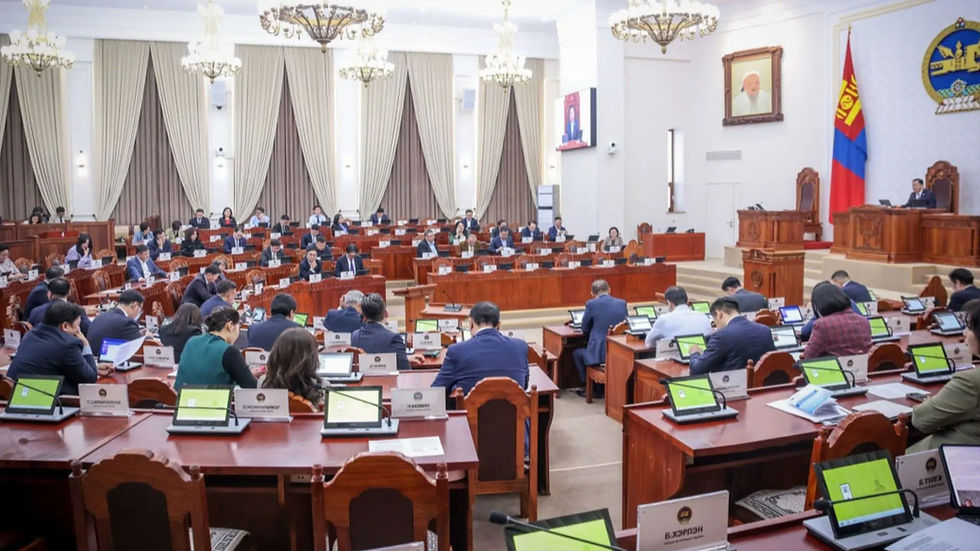
Mongolia’s ruling party has opted for continuity over confrontation. On June 13th, Parliament confirmed Gombojavyn Zandanshatar (age 55) as Prime Minister with 93% of votes, signaling total party discipline following Luvsannamsrain Oyun-Erdene’s abrupt resignation.

But Zandanshatar’s elevation says less about his personal stature than about the political imperatives driving the Mongolian People’s Party (MPP): factional containment, legislative stability, and the preservation of a long-term succession plan that may culminate in the 2027 presidential race.
Zandanshatar was not the most dynamic option. Nor was he the most policy-minded. But he was the least objectionable across rival MPP factions, and crucially, palatable to President Ukhnaagiin Khurelsukh. That neutrality proved decisive. Finance Minister Javkhlan faced resistance from MPs aligned with Temuulen, who had unsuccessfully challenged Zandanshatar at the MPP conference. MP Temuulen now aims to succeed the Finance Minister.
Cabinet Secretariat Chief Uchral alienated the party’s youth wing and bore the blame, rightly or wrongly, for contributing to the collapse of the Oyun-Erdene’s cabinet. Foreign Minister Battsetseg and Agriculture Minister Enkhbayar lacked the cross-party credibility needed for a government to endure effectively. Parliament Speaker Amarbayasgalan withdrew his name.
Zandanshatar, by contrast, carried little factional baggage. A former Speaker, foreign minister, and chief of staff in both the cabinet and presidency, he brings institutional experience and a reputation for quiet diplomacy over ideological zeal.
His appointment was packaged as a “generational consensus” within the MPP. This was less a bold political choice, more a risk-averse compromise intended to avoid disruption.
That conservatism is reflected in the tasks now before him. He inherits a government hemmed in on all sides: falling coal export revenues, a projected 2.3 trillion tugrik(~$667 million) budget shortfall for 2025, and an energy system exposed by the fire at TPP-3 in early June. Winter looms, and with it, the threat of heating shortages and rolling blackouts in Ulaanbaatar.
To his credit, Zandanshatar has not sugarcoated the severity of the situation. In his remarks to Parliament, he called for fiscal restraint, bureaucratic streamlining, and a push to finalize negotiations with companies managing strategic mineral deposits—decisions with implications for the credibility of the National Wealth Fund law.
But rhetoric will not be enough. Under constitutional amendments he helped pass as Speaker, the Prime Minister now has sweeping authority over cabinet formation. He can no longer deflect responsibility onto coalition dynamics or presidential interference.
The composition of his cabinet will be the first real test: does he reward party loyalists, or appoint competent reformers, particularly in finance, energy, and mining?
The foreign policy front presents more continuity than risk. Zandanshatar helped anchor Mongolia’s “third neighbor” policy during his time as foreign minister, and reaffirmed it in his address to Parliament.
With Beijing, Moscow, and Washington all carefully monitoring Ulaanbaatar’s orientation, his steady hand offers reassurance. His Western credentials, anchored in academic ties to Stanford, and fluency in Russian also make him legible in all relevant capitals. But geopolitical balance will not shield him from domestic political turbulence.
Indeed, the question is whether Zandanshatar intends to govern or simply to manage. His appointment offers the MPP breathing room, not strategic direction.
With the corruption further deepening, and public trust in long-term decline, the temptation will be to avoid hard fights. Yet the cost of inaction will be high: a bloated state, deepening public debt, and growing political apathy.
Ultimately, Zandanshatar seems to be less a symbol of renewal than a placeholder for the party’s next move. He was not elevated to lead a reformist charge, but to stabilize the party’s hold on power.
Whether he becomes a transitional figure or a genuine power center will depend not on his pedigree, but on his willingness to make hard decisions and take personal risks. For now, he represents the MPP’s bet that unity and continuity are more important than urgency.


Comments