
The 2027 Mongolia Election Campaign Begins Early: A Corruption Raid on an Opposition Associate Signals What’s to Come

Mongolia’s next presidential election is two years away. But the early contours of the race are already coming into view. A recent raid by the country’s anti-corruption agency on a close associate of Sainkhuugiin Ganbaatar, a populist opposition lawmaker and former presidential candidate, suggests the field is being shaped well ahead of time.

Formally, the case concerns old allegations tied to the Mongolian Trade Union Confederation, which Mr Ganbaatar once led. Investigators suspect that senior union figures sold off valuable land holdings to private developers under dubious terms. Mr Ganbaatar’s past leadership provides, on paper, a legitimate thread to pursue.
But context makes the raid hard to read as purely procedural. Mr Ganbaatar denouncedit as politically orchestrated. His claim, though self-serving, resonates. The opposition sees the move as part of a broader campaign to narrow the field ahead of the 2027 contest and to remind rivals that no past is off limits.
The raid came days after President Ukhnaagiin Khurelsukh, in a televised address to parliament, alluded to a politician accepting 50 million won from South Korean donors, a thinly veiled jab at Mr Ganbaatar and a revival of a long-dormant scandal. The anti-corruption sweep that followed looked, to many, like a follow-up act.
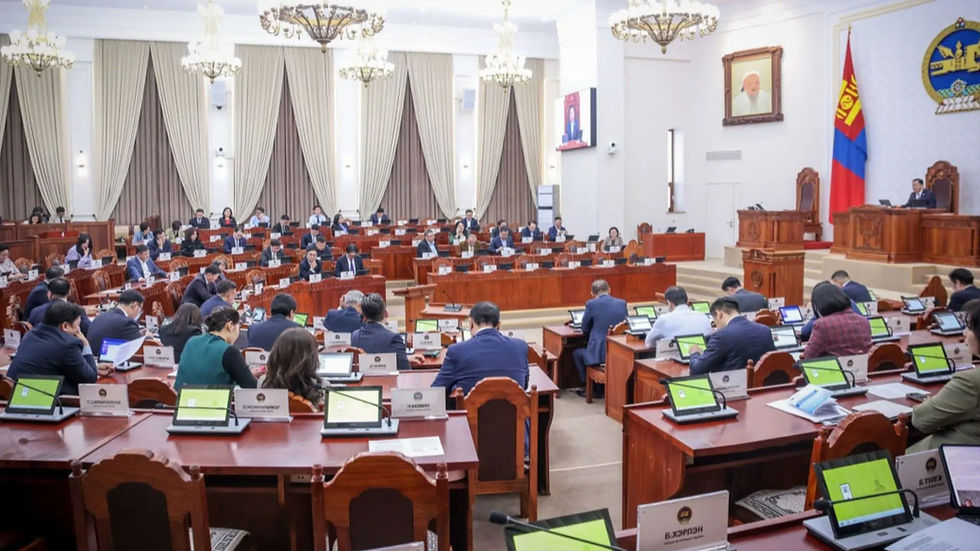
This isn’t happening in isolation. The episode follows Mr Khurelsukh’s role in ousting the prime minister earlier this month. That maneuver exposed rifts inside the ruling Mongolian People’s Party (MPP), and confirmed the president’s grip over its inner workings. It also reaffirmed a pattern: potential challengers, whether inside the party or out, are being systematically weakened.
Mongolia’s Independent Authority Against Corruption (IAAC), which carried out the raid, is nominally autonomous. But its actions often reflect the prevailing political winds. The executive branch has recently intensified pressure on other independent institutions as well.
The Prime Minister, days before his removal, accused the Chief Justice and senior judges of shielding land-related corruption, particularly in ecologically sensitive areas near Bogd Khan Mountain. Even if the claims hold merit, their timing casts doubt on intent.
This climate has made the IAAC’s work appear less like neutral enforcement and more like selective prosecution. The message to would-be presidential candidates is clear: your past is now political currency.
It’s not just Mr Ganbaatar who is under pressure. Allegations tied to the Tugrug Nuur coal deposit were recently revived against former President Khaltmaagiin Battulga, another likely contender in 2027. Neither case is new, but both are being reanimated with fresh intensity, and in ways that serve the current leadership’s interests.
The tactic is effective. It disorients opponents, muddies their reputations, and signals that no one is immune. But it also risks backfiring. Politically motivated investigations might still unearth genuine wrongdoing. In doing so, they create a strange duality where partisan attacks end up advancing, however unintentionally, the anti-corruption agenda.
That ambiguity reflects a deeper tension in Mongolian politics. The country has built institutions meant to uphold transparency and integrity. But when such tools are perceived as levers of power rather than instruments of justice, public trust corrodes. As the 2027 race takes shape, corruption will remain both a central issue and a weapon.


Comments