
Mongolia's High-Stakes Uranium Mining Game

Timing couldn’t be better. Rising uranium demand, driven by a nuclear resurgence and geopolitical pressures, strengthens Mongolia's uranium mining bargaining position.
With the nuclear energy law amendments made in November 2024 Mongolia is signalling a sophisticated attempt to unlock its uranium potential while safeguarding national interests.
These changes set the stage for a $1.7 billion uranium project with France’s Orano Group—a deal long stalled since its protocol signing in late 2023.

With parliamentary approval secured, the final agreement could be ready before the Lunar New Year in 2025, although parliamentary hurdles remain. The new legislation introduces several significant changes.
It bans foreign radioactive waste imports, aligning with Mongolia’s environmental commitments.
It also replaces fixed resource-use fees with a dynamic structure starting at 5% of sales value and climbing to 8% when uranium prices surpass $80 per pound. With uranium prices hitting $82/lb in November 2024, this ensures Mongolia can capitalize on market surges.
Another key provision allows parliament to replace equity stakes (such as the state's 34% in the Orano project) with special payments, giving flexibility in revenue management. This adaptability aims to streamline project structures while maximizing financial returns. Licensees must now shoulder full responsibility for radioactive waste management, addressing regulatory clarity concerns but leaving debates on health assessments unresolved.
To bolster investor confidence, the law incorporates tax stabilization clauses, echoing global best practices. Shifting from common to preferred shares ensures Mongolia benefits from consistent revenues while mitigating project risks during volatile market cycles. These steps reflect a calculated move to attract investment while retaining strategic oversight.
Mongolia’s timing couldn’t be better. Rising uranium demand, driven by a nuclear resurgence and geopolitical pressures, strengthens its bargaining position. On top of that, Niger's military junta is disputing a decision by Orano to halt uranium production.
The revised legal framework offers a balance between enticing investors and securing long-term returns. However, local sensitivities about resource ownership persist, requiring the government to tread carefully.
Orano’s joint venture with state-owned Mon-Atom (aka Badrakh Energy) highlights these tensions.
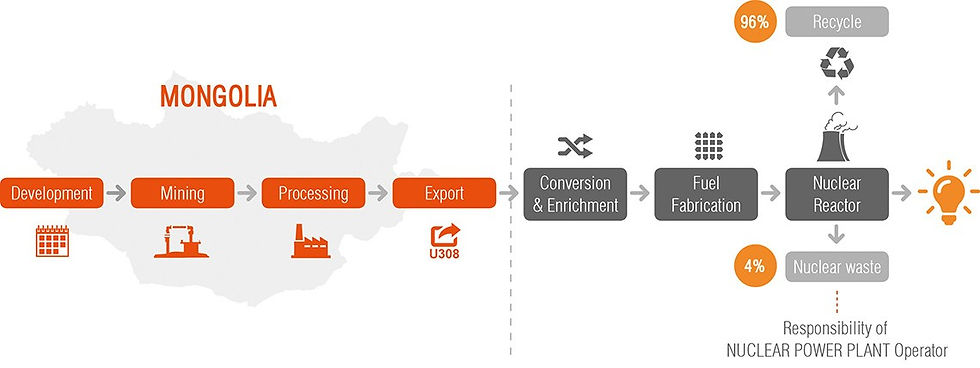
The project promises technological expertise and economic benefits but must also navigate local skepticism. Compensation mechanisms, such as payments to affected communities, and plans for domestic uranium mining using locally sourced materials, aim to address these concerns.
The parliamentary debates underscore Mongolia’s tightrope walk between sovereignty and investment. Lawmakers rejected a production-sharing model, preferring royalty payments to retain control over uranium resources. However, this approach could slow development, reflecting deep-seated political wariness about foreign influence over strategic assets.
Environmental safeguards also sparked debate. Current rules mandate upfront reclamation payments, which some argue deter investors by increasing project costs. Alternatives, like phased reclamation trust funds, could offer a more balanced solution, but these remain contentious.
The broader challenge lies in ensuring transparency and public trust. As Mongolia's uranium mining advances, clear communication about its economic and environmental impacts will be crucial. Parliament must not only legislate wisely but also manage public perceptions—a task requiring as much finesse as the law itself.
Mongolia’s uranium mining push reflects a nuanced strategy to harness a critical resource while safeguarding national interests. The updated framework shows promise but must navigate political, economic, and environmental complexities to succeed. For Mongolia, the uranium gamble is not just about investment—it’s a test of its ability to strike the right balance between opportunity and control.


Comments